
Beyond the Label: Understand The Mental Health of Neurodivergent Individuals


Have you ever felt this? You’re in class, the lights suddenly feel way too bright, the noises feel way too loud, and your leg just won’t stop bouncing. When a teacher says, ‘Stop fidgeting, ’ they’re probably just trying to keep order – but for that student, it feels like a heavy weight they cannot explain. Watching my friends go through moments like this make me realised that some of the pressures in school are invisible. Environments that feel totally normal to most of us can actually be a massive challenge for others.
What does neurodivergence really mean?
Neurodiversity just like there are millions of different species in nature, there are tons of natural ways for the human brain to work. Everyone’s brain is wired differently—from how we process info and feel the world around us, to how we talk to people. Neurodivergent people have a different 'operating system' installed. This gives them unique strengths and perspectives, but it also means that trying to fit into a world built for the 'standard' system can be a real struggle.
Common types of neurodiversity include Dyslexia, Attention Deficit Hyperactivity Disorder, Autism Spectrum Disorder, Specific Learning Disorders, etc. In Hong Kong, it is estimated that 15 - 20% of the population is neurodivergent, including 2.57% of youth aged 6-17 are autistic, and 6.4% of children and adolescents have ADHD (HKU Med, 2018).
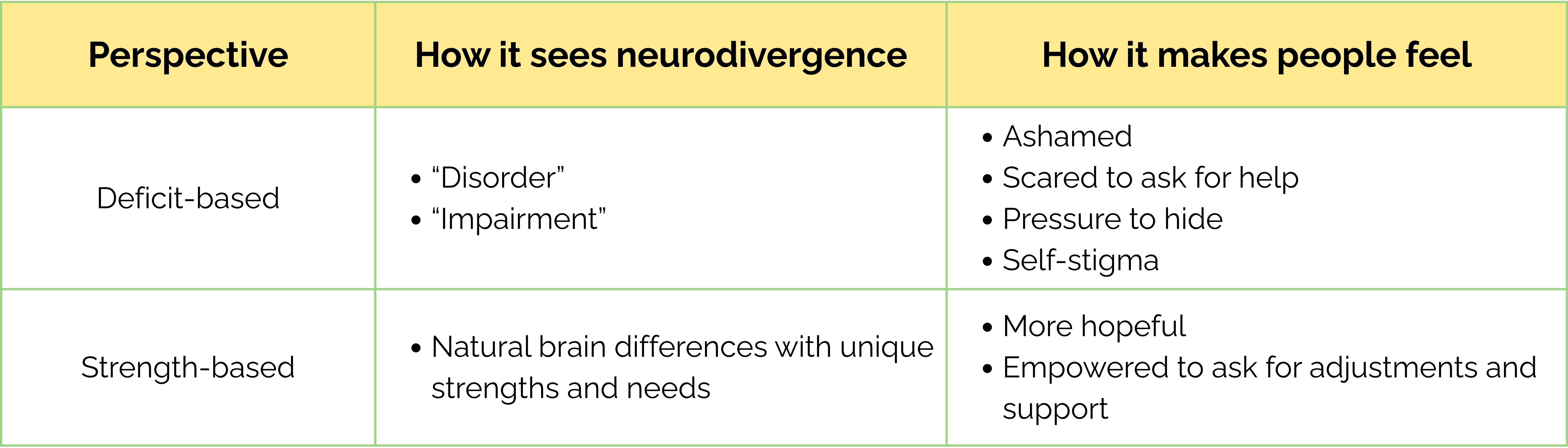
Strength-based vs deficit-based perspectives
A strength-based perspective celebrates and embraces people’s natural differences, for instance,
- ADHD: Hyperfocus, instant knowledge consolidation, and creativity
- Autism: Strong pattern recognition, attention to details
- OCD: Exceptionally strong problem-solving skills, intense dedication
A deficit-based view often sees neurodivergent individuals as “broken” and “something needs fixing”.
Mental health challenges for neurodivergent youth – The Double Stress
In a world designed for the 'majority,' most neurodivergent teens are stuck trying to manage their mental well-being in environments that just don't get them. This is especially true in Hong Kong, where the school culture is all about competition and exam results. In a place like that, the pressure of feeling like you 'don't fit the mold' gets dialed up to the max, making everyday learning feel like an uphill battle. It’s often the tiny details that people overlook that cause the most stress. Here are the small, everyday struggles that turn into a constant tug-of-war for their mind and body:
- Sensory Overload: Many autistic or ADHD people experience overstimulation, more sensitive to light, sound, crowds, or touch. For example, noisy classrooms, packed MTR trains, and brightly lit public areas can make everyday life exhausting.
- Academic and social demands: These may lead to burnout and exhaustion since they are required to constantly adapt to school demands, mask their difficulties, and push beyond their limits.
- Social masking: Hiding their natural behaviors to appear “normal”, is a common practice among neurodivergent youth. For instance, forcing eye contact, rehearsing what to say, or suppressing stimming.
- Stigma: The most frustrating thing is that because people don't understand what's actually going on, these students often get labeled as 'lazy,' 'difficult,' or 'dramatic.' Without the right support, they end up stuck with these negative reputations.
Many neurodivergent individuals also experience co-occurring mental health conditions. About 70% of people with autism spectrum disorder have at least one co-occurring mental health condition, most commonly anxiety and depression.
In short, many autistic people are not only managing neurodivergence but also navigating mental health challenges at the same time.
What I wish my peers knew and what we can do
After seeing how neurodivergent friends were treated, I started asking myself: what would have actually helped them? What can people at our age do differently to advocate for them? Here are a few things I’ve learned and keep reminding myself:
- Believe people when they say something is hard: If someone says the classroom is too loud, the lights are painful, or they can’t focus the way you do, take it seriously even though you don’t experience it the same way.
- Avoid the “lazy” label: Before calling someone lazy, consider that they might be spending twice as much energy just to do what comes naturally to you. Their efforts are not always visible.
- Respect their coping strategies: Noise-cancelling headphones, taking short breaks, fidgeting, or avoiding eye contact might seem “strange”, but for many neurodivergent people, those are how they calm themselves down.
- Notice then ask: Instead of jumping to conclusions when someone seems off, first notice what’s happening (for example, they are covering their ears, they leave their seats suddenly), then gently try asking “Hey, are you okay?” or “Is there anything that would make this easier for you?”
- Zero tolerance for bullying: It’s easy to make fun of someone who doesn't follow the crowd, but it takes way more heart and courage to actually try and understand them. When you see someone being treated unfairly or left out, be the one to step up. You don't have to be loud about it—just be a steady, supportive presence. I truly believe that creating a space that’s kind to mental well-being and inclusive for everyone is a job for all of us together.
We can’t reform school rules and other policies overnight, however there is one thing that we can change: the way we treat the people in our community. If we move beyond enforcing labels and actually listen to neurodivergent youths’ voices, we’re not only contributing to their mental wellbeing, we are also making Hong Kong an inclusive space for more kinds of brains to feel belong. When you come to think of it, having a more inclusive and caring environment benefits all of us, not just the people who are told that they’re “too much”! Let’s work together to ensure that every individual finds their place in this city!
---------------------------------------------------------------------------------------------------------------------
Reference:
- Cleveland Clinic. “Neurodivergent: What It Is, Symptoms & Types.” Cleveland Clinic, 2 June 2022, my.clevelandclinic.org/health/symptoms/23154-neurodivergent. Accessed 16 Jan. 2026.
- “HKU Finds ADHD Drug Use Increase in Hong Kong and 13 Different Countries Safety and Efficacy of ADHD Drugs Monitoring Indispensable.” Med.hku.hk, 2018, www.med.hku.hk/en/news/press/HKU-finds-ADHD-drug-use-increase-in-Hong-Kong-and-13-different-countries. Accessed 20 Jan. 2026.
- Miller, Caroline. “What Is Neurodiversity?” Child Mind Institute, Child Mind Institute, 2023, childmind.org/article/what-is-neurodiversity/.
- “NDAHK.” NDAHK, 2024, www.ndahk.com/. Accessed 17 Jan. 2026.
- Wong, Oscar Wh, et al. “Autism Epidemiology in Hong Kong Children and Youths Aged 6-17: Implications on Autism Screening and Sex Differences in the Community.” Autism : The International Journal of Research and Practice, 2025, p. 13623613251360269, pubmed.ncbi.nlm.nih.gov/40717427/, https://doi.org/10.1177/13623613251360269.

